

October 21, 2026
Nick's Coffee Chronicles: What I Learned Touring 3 Hawaii Coffee Farms
Roastar's Specialty Coffee Ambassador Nick Schmitt got a firsthand look at how coffee is grown and processed at three different Hawaii coffee farms.
How Coffee is Processed at Hawaii Coffee Farms
During my time in Hawaii, I had the opportunity to tour three different coffee farms.
Each farm approached coffee growing a little differently, and together they gave me a much better understanding of how farming practices, processing methods, and even the surrounding ecosystem shape the coffee-growing process.
I learned that Maui's volcanic soil makeup and unique microclimates vary significantly across the island, reinforcing that a coffee's origin goes deeper than the country, state, or even the island that it's sourced from. It truly starts at the coffee farm.
Kupa’a Farms: Building Healthy Soil
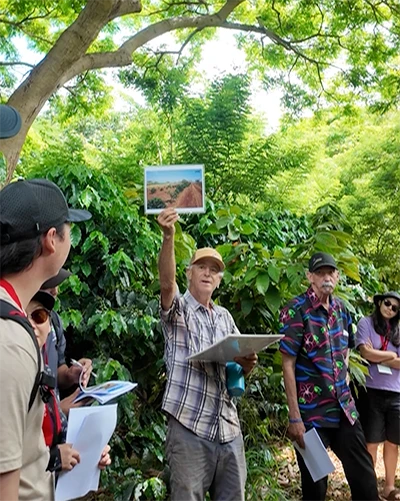 We visited Kupa’a Farms about a month before peak harvest, so the trees were covered in coffee cherries, though most were still green and not quite ready to be picked.
Farmer Gary told us about the transformation the farm has undergone and the work that goes into maintaining an organic coffee farm. For anyone interested in composting, this farm is especially impressive. Each year, Kupa’a Farms diverts approximately 52 tons of food waste from the landfill and puts it to use on the farm.
We also learned how the various types of shade trees were selected with care to grow quickly and protect the coffee plants from getting too much sun, but not drop seeds. As an added bonus, when the leaves fall and cover the ground, they break down and add nitrogen to the soil.
I also noticed cacao trees planted among the coffee trees. This creates variety in root depth while also providing another crop that can be harvested in addition to the coffee.
O’o Farm: From Seed to Cup
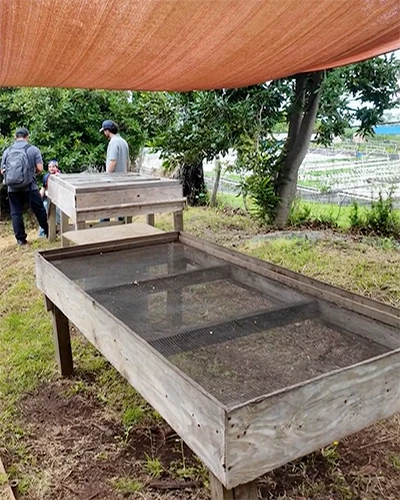 O’o Farm offered a different look at coffee production. The farm primarily operates as an agritourism destination, offering guided farm-to-table experiences where visitors can tour the property and enjoy meals prepared on-site using vegetables grown on the farm.
It also offers a seed-to-cup coffee tour that walks visitors through the entire coffee process, from growing and harvesting to processing and roasting. Coffee occupies approximately two acres of the farm and produces roughly 1,000 to 2,500 pounds of green coffee each year. Rainfall levels, temperature, and severe weather are all factors that affect how much coffee is harvested.
One of the most interesting parts of the visit was seeing how much of the processing happens directly on the property. O’o Farm has a wet pulping machine for removing coffee beans from the cherries. Drying is currently one of the farm’s biggest processing bottlenecks, so in addition to raised drying beds, they modified refrigerators with dehumidifiers to speed up that process.
Ka’anapali Farms: Coffee, Mountains, and Spiders
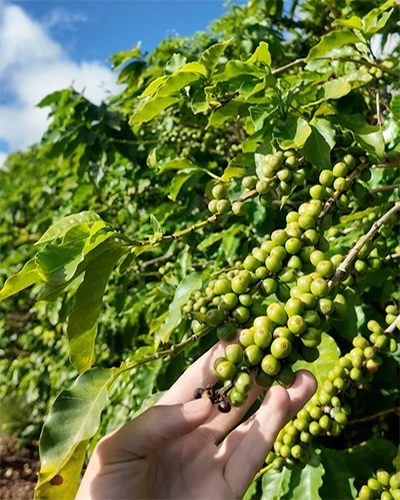 Ka’anapali Farms was a slightly larger operation nestled near the base of the mountains. I climbed into the back of a pickup truck and headed out into the fields to see the coffee trees.
One thing I was not quite prepared for was the spiders. Golden orb weavers are a natural part of the coffee farm ecosystem and help control insects that could otherwise damage the crop. That sounds great in theory—until you walk directly into the web of one of the largest non-tarantula spiders in North America. It was certainly one of the more memorable parts of the trip.
Conclusion
It was spectacular to taste and experience coffee growing for the first time. Hawaii is different from many of the world’s major coffee-growing regions, and getting to see coffee production firsthand gave me a new appreciation for everything that happens long before coffee reaches a roaster.
Stay in the know—subscribe to Roastar emails for product updates, special offers, packaging tips, and design inspiration.